

Designer: Daryl Chow Publisher: Origame
Rainforest City is a nature-themed tile-placement which sees you trying to build the best, most sustainable, habitats for an array of Singapore’s flora and fauna – you’ll be making homes for termites, tree-climbing crabs, and pangolins, amongst others.

Gameplay is simple – each player is assigned a player fruit, and cards are arranged around the central fruit dial offering habitat and wildlife cards in various configurations. On your turn, you turn the fruit dial to the cards you want and take both to place into your landscape, your opponents take one card from the section their fruit is pointing at.
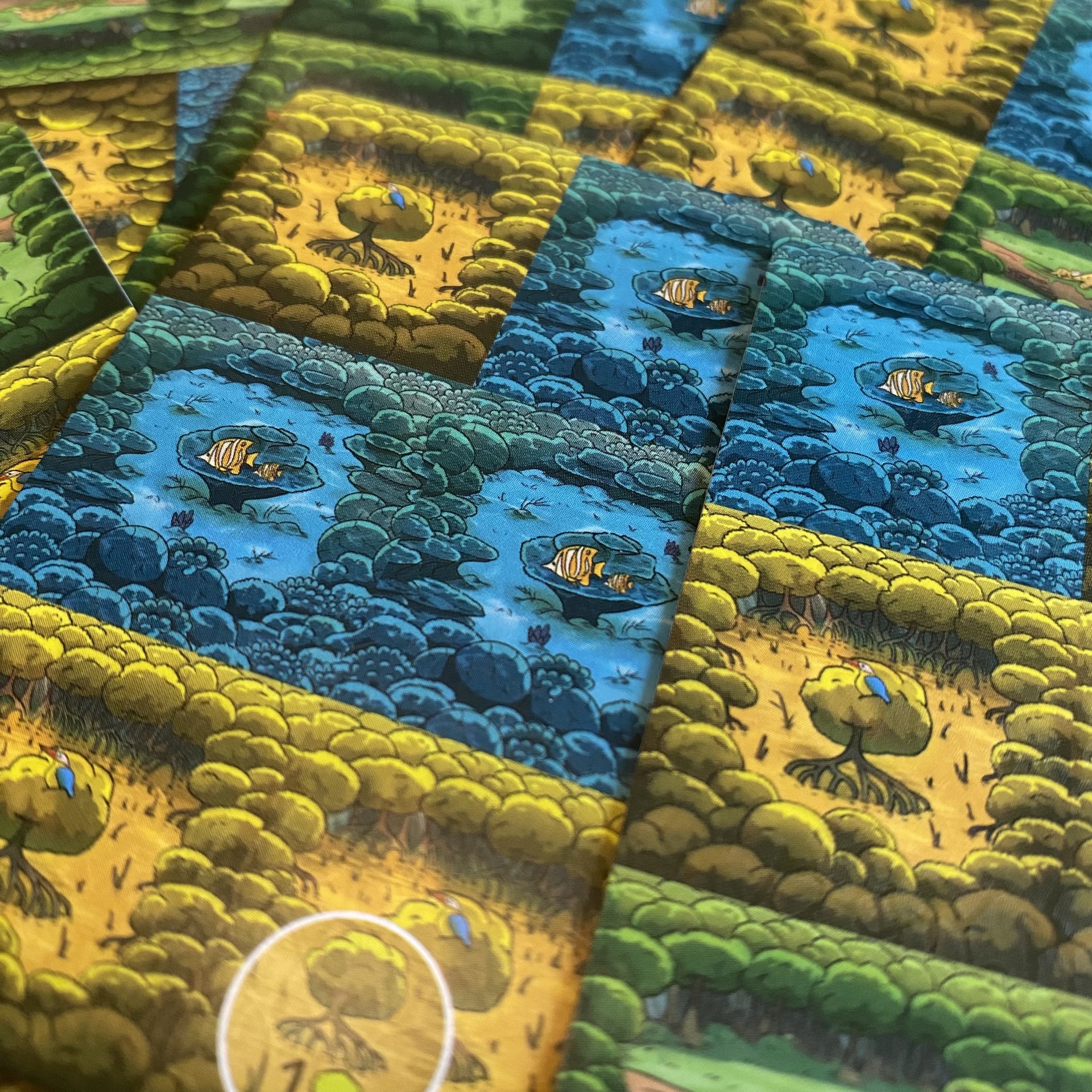
Habitat cards, plus any wildlife on the cards, are played directly into your landscape with the goal of creating large, wildlife-rich areas.
Wildlife cards present a 2×3 grid – you can rotate the card as you wish but the idea is to place the wildlife orientation shown on the card into the correct habitat(s). Anything you’re unable to place goes into the compost bin for negative points.
The game continues, with main player duties rotating, until twelve rounds have been played. And then it’s final scoring time.

Final scoring is both simple and clunky at the same time. You score points for supported fauna, so you need to work out what is, and isn’t, supported in each habitat, which can be a little fiddly when your board is littered with wildlife tokens which cover most of the square they’re on – especially when it comes to the otters, which can be played into any habitat, so you need to pay more attention to where their dinner is coming from. There’s also some scoring which is not adequately explained in the instructions, coming as both a surprise when you get to the end game score section and a bit of a “how do you interpret this?” moment which is not something you want at the end of what is a quick and fun game.
The artwork throughout the game is eye-catchingly colourful. Both the habitat cards and wildlife tokens are beautiful, it’s just a shame that so much of the habitat is covered by the tokens. I feel like the habitat cards should be about twenty-five percent bigger to better accommodate the tokens and make everything feel less fiddly.
But those complaints aside, it’s a fun little filler of a game taking about 20-30 minutes to play through and there’s plenty of scope for expanding the experience with the various different goal cards offering bonus points for the largest area of a certain habitat or for having a collection of certain types of animals.
 Geofortean's Game Space
You must be logged in to post a comment.