Illiterati

Designer: Gary Alaka, Rob Chew, Jon Kang Publisher: Gap Closer Games

It’s time to sack off Scrabble and walk away from Wordle because there’s a wonderful new word game in town.

Illiterati from is a cooperative word game which pits you, as a member of the League of Librarians, against the titular Illiterati – a group of ne’er-do-wells who want nothing more than to destroy the written word, starting with all the books in the library.

Over numerous three minute rounds it’ll be up to you to restore a set number of these books, depending on the difficulty, by fulfilling the criteria on their pages. Bind enough books and you’ll face the Final Chapter – a tense climactic battle against the Illiterati which is harder than anything you’ve faced so far…

First things first, Illiterati is beautiful – from the book-themed box downwards, everything is beautifully produced. The letter tiles are nice and chunky – exactly what you need when shuffling them around against a strict time limit. The cards are nice and big, with eye-catching artwork on the Illiterati cards, and be sure to take some time to enjoy each and every literary pun on the book cards.

Starting with a handful of letters, which you add to each round, you need to make words – ideally words that fit the criteria on your book card – to survive the round. Your goal in these timed rounds is to use all the letters you and your teammates have at your disposal. You can freely move letters – and whole words if you so desire – between your teammates, with permission, and you also have a few extra letters in the library (the number varies depending on the difficulty level you’re playing) which you can also draw upon. When the time ends, any unused letters or misspelt words are returned to the library and should the number of letters exceed the library limit (which is, at most, three) then one of those letters will be chosen at random for burning.

And this is where the cooperative nature of the game really shines through. Illiterati works on an all-or-nothing principal which actively encourages teamwork and stops people solely focusing on their own collection of letters. If a letter is burnt in a round then no-one can bind a book, even if they have met the criteria for it meaning that all the words on the table – even the ones that could have been used to complete a book are under threat from the Illiterati.

Whether you succeed in the round or not, the Illiterati then take their shot at you. Their attacks range from restricting the draw limit to getting rid of whole words from the play area. The worst one, I think, is one in which you have to lose two letters from every word you have made. And while each round affords you more letters to meet the book challenges, drawing an Illiterati that’s already in play sees their attacks chain together. And that can be devastating!

The Final Chapter further solidifies the cooperative nature of the game – every player must complete the challenge as though it was their own personal book. So if, say, the final challenge is to produce words totalling more than 12 letters, with five matching symbols, on the subject of “shapes and maths terminology” then every player has to achieve that goal in the same round to win the game.

It’s ridiculously good fun. It’s a great game to play with people, and the solo mode (which sees you drawing a few more tiles each round) holds up well. There is an adversarial mode too, which I haven’t yet tested, but from the looks of it, that’ll be just as much – if not more – fun that the other modes on offer.

The only negatives I have are that the “normal” mode is way too easy after your first couple of tries at the game (in fact Gap Closer have said that they were originally going to call it “easy” but felt bad when people struggled) and that the sand timer is very easy to forget about, so you completely miss the three-minutes running out so I tend to favour a digital timer.

But that’s the only bad thing I have to say about this game. It’s bright, it’s colourful, it’s fun. There’s a lot of player interaction and some genuinely tense moments as you try to juggle the worst collection of consonants you’ve ever seen outside of Wales into anything even resembling a word.

Great stuff.
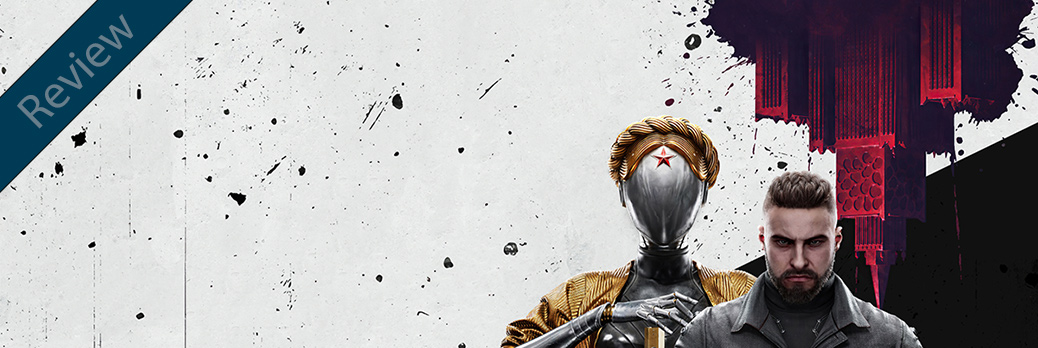
Atomic Heart

Developer: Mundfish Publisher: Focus Entertainment
Available On: PlayStation 4, PlayStation 5, Xbox One, Xbox Series X/S, PC

I’d been playing this for around an hour or so before I was first treated to the bizarre design choice of an character upgrade system that is, for all intents and purposes, a sexually inappropriate fridge. And this serves to highlight one of the biggest problems with Atomic Heart – it just won’t shut up.

Approach that fridge with caution…

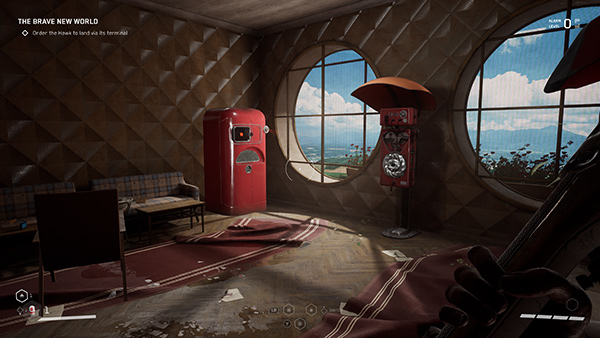
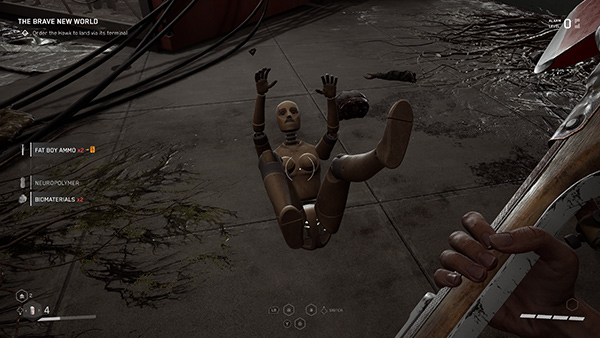
But let me set the scene. This game is set in an alternate history version of 1955. We’re in Facility 3826, the Soviet Union’s foremost scientific research division where they’ve developed a substance called Polymer that has led to breakthroughs in the fields of energy and robotics. The robots – the majority of which resemble shop mannequins with dodgy porn moustaches – in the facility have gone mad and killed most of the human workforce. You need to sort it out.

Well, you and your talking, robotic glove. Because obviously.

The problem with this game – as I mentioned – is that it won’t shut up. The glove talks. You talk to the glove. But the voice work – it feels like too much of a compliment to call it “acting” – is terrible. And the script is even worse. Given that the game is set in Russia – itself a contentious issue, anyway, given that the game also released a year after the invasion of Ukraine amongst other things – there’s a few stereotypical Russian accents and a dodgy German one, but for the most part everyone has an American accent. And our hero, known as P-3, whilst dropping f-bombs in almost every conversation will shout the same out-of-place thing when something bad happens – “Crispy critters!”

And then you’re sexually assaulted by a fridge.

These inactive robots are strewn all over the place

None of the dialogue is skippable and it’s all awful. If it turned out the whole thing had been written by an AI I wouldn’t be surprised. It’s hard to believe it’s been written by anyone who’s ever talked to anyone else in their entire life. And the fridge bits, in particular, make your toes curl and you just want it to be over. It really outstays its welcome, and when you’ve visited a few fridges where it doesn’t happen you think it’s all over, only for the next fridge to start the whole process again. You need to upgrade your character to get anywhere with the game, but you also don’t want to because five minutes of foreplay to get to a skill tree is about five minutes too much.

Gameplay wise, it’s a first-person exploration, melee and shooting thing. Think Bioshock but with all the fun sucked out of it. The weapons are alright, I suppose. You unlock powers for your glove – again, think Bioshock – but they’re nowhere near as much fun as unleashing a wave of crows or whatever. And, aside from a teensy icon at the bottom of the screen, there’s little to no indication of what power you’re about to unleash and chances are it’ll be the wrong one. Atomic Heart also has a love of tutorial screens the likes of which you have never seen. It felt like the first couple of hours of the game were constantly grinding to a halt because they game needed to pause and tell me things. And on the subject of slowing down – the lift journeys in Atomic Heart rival those of Mass Effect for length with no indication of progress, to the point where you will convince yourself the game has crashed. There’s a few bits where the frame rate suffers dramatically as well, one noticeable bit reasonably early on with a whole three forklifts is laughable when you consider the likes of Plague Tale taking care of 1000s of rats at once.

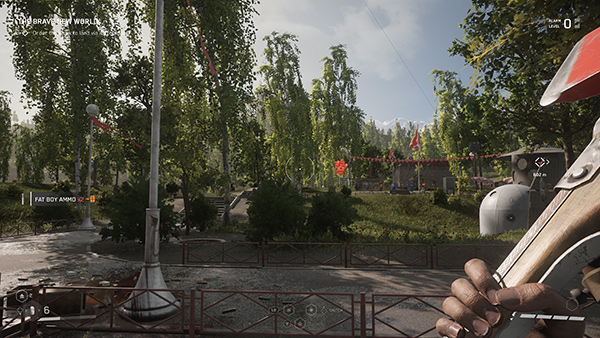
The lush green trees hide many a killer robot

Graphically, the outside stuff looks really nice. It’s nice to stand on top of a structure and look across the map at stuff, but when you walk there in the open-world element of the game you’ll find moments where your surroundings suddenly pop into existence. When you’re inside the various facility buildings though, it’s dullsville – generic corridors with a path that, even though there is scope for exploration (which will normally get you nothing more than a few upgrade materials), feels incredibly linear. This is especially true of the Test Areas which are, basically, puzzle dungeons that house upgrade chests. Solve a puzzle, open a chest, rinse and repeat. A few of them have a bit of combat in them – one has a ridiculously hard boss which will kill you with little-to-no warning – but it’s still a linear experience.

Speaking of being killed, save points. There are manual save points and autosaves. Except the autosaves are, with a few exceptions, triggered solely in the same room as the manual save point. And the manual save points can be – or feel – few and far between. I encountered a game-breaking glitch yesterday with a puzzle element being irretrievably dropped by your character if you went the wrong way. It’s not the first poor design fault I’ve found – my favourite so far is the fact that the game collapses a room you’ve previously had no access to on top of a collectible item which you’ve also had no access to and you then can’t collect it.

And yet I’m still playing it. So there’s something there. What it is, though, I’m not sure. It’s not the combat or the voice acting. It might be the exploration elements of the open-world, or the completionist nature of some of the achievements.

It’s kind of like picking at a scab. Not everyone does it, but those that do know they shouldn’t. You know that it’s probably going to leave a mark and yet you do it anyway.


Games With Gold March 2023

The Games With Gold titles have been released for this month and there are three titles up for grabs during the month.

Trüberbrook
Available from March 1st to March 31st

Trüberbrook was originally released in 2019 after a successful Kickstart campaign, and is a point-and-click adventure set in the titular German town which lets you delve into an alternative cold war era and a sci-fi mystery involving quantum mechanics and a dose of anthropology.

Sudden Strike 4: Complete Collection
Available from March 1st to March 31st

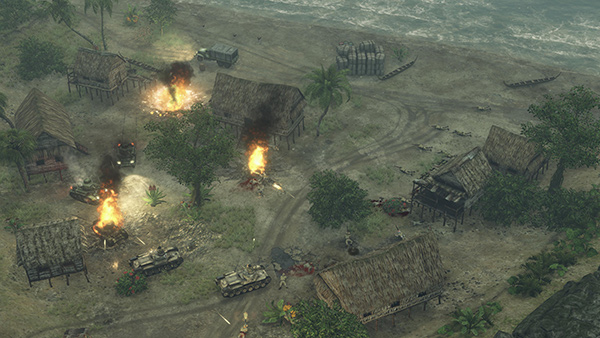
Sudden Strike 4 is the fifth game in the Sudden Strike series of real-time tactical battles set during World War II. The complete collection comes with 6 DLC packs, plus all free content updates including some missions not included in the base game.

Lamentum
Available from March 16th to April 16th

Lamentum is a pixel art survival horror – a mixture of problem solving, bizarre-shaped key collecting and monster killing – heavily inspired by the likes of Resident Evil and Silent Hill, centred around the lengths that a young aristocrat will go to in order to save his terminally ill wife.