Tag Archives: Origame

Durian Dash

Designer: Daryl Chow Publisher: Origame

Durian Dash is a game about collecting the “king of fruits”, the incredibly stinky but nutritious and, apparently, delicious durian fruit.

Each player has a secret mission to collect certain types of durian for bonus points and avoid others to dodge penalty points, and gameplay is so simple.

Playing an action card determines what you can do each turn – picking up fruit, placing down fruit or passing fruit to an opponent. The lower your action card number the earlier you take your turn, and as the market isn’t replenished until all players have made their moves it might prove important to get in there first if there’s a durian at the head of the market that takes your fancy – you don’t want to get stuck with the rotten ones! Or maybe you do if you have a handy passing action up your sleeve to give the manky fruits to your opponents. Once each player has taken their actions the market is restocked and play continues until there’s no more cards to replenish the stalls. Tot up your fruits, including any bonuses and negative points and the highest score wins. There’s also a durian hater mode with identical gameplay but you’re aiming for the lowest score.

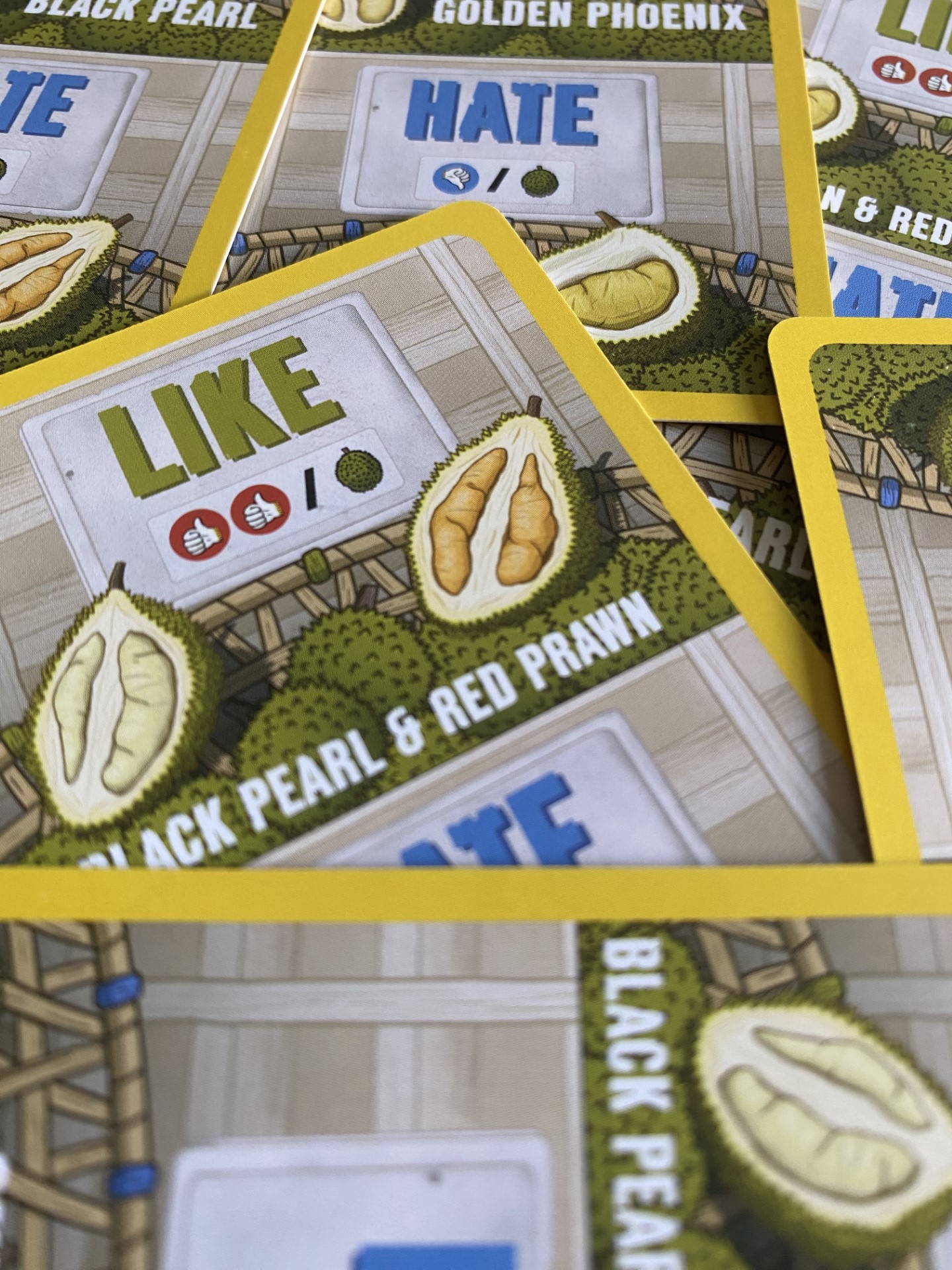
The art work in this game isn’t particularly eyecatching once you get past the huge abundance of yellow on offer. There’s not a vast array of difference from one durian to the next, aside from the number of stones in each fruit. Each durian type has a different coloured border and identification text but it can get lost in the sea of yellow cards. It wasn’t too much of a problem in a two-player game but with six players there’ll be an awful lot of durians in play and I think it’d be a little bit harder to pick out the ones you want. But then, simplistic artwork for a simple game works brilliantly in things like Point Salad, so it’s not all bad.
One thing that I would mention is that the game box states that the game is for 3-6 players but this is misleading and initially put me off even looking in the box as it’s only about once a week we’ll play as a three(or more)some, but the game is actually for 2-6 players and the the instructions focusing on a two player set-up in many of the examples.

Other than that, it’s another quick, fun and easy to learn game – something which the selection of titles from Origame provides in abundance.

Rainforest City

Designer: Daryl Chow Publisher: Origame

Rainforest City is a nature-themed tile-placement which sees you trying to build the best, most sustainable, habitats for an array of Singapore’s flora and fauna – you’ll be making homes for termites, tree-climbing crabs, and pangolins, amongst others.

Gameplay is simple – each player is assigned a player fruit, and cards are arranged around the central fruit dial offering habitat and wildlife cards in various configurations. On your turn, you turn the fruit dial to the cards you want and take both to place into your landscape, your opponents take one card from the section their fruit is pointing at.

Habitat cards, plus any wildlife on the cards, are played directly into your landscape with the goal of creating large, wildlife-rich areas.

Wildlife cards present a 2×3 grid – you can rotate the card as you wish but the idea is to place the wildlife orientation shown on the card into the correct habitat(s). Anything you’re unable to place goes into the compost bin for negative points.

The game continues, with main player duties rotating, until twelve rounds have been played. And then it’s final scoring time.

Final scoring is both simple and clunky at the same time. You score points for supported fauna, so you need to work out what is, and isn’t, supported in each habitat, which can be a little fiddly when your board is littered with wildlife tokens which cover most of the square they’re on – especially when it comes to the otters, which can be played into any habitat, so you need to pay more attention to where their dinner is coming from. There’s also some scoring which is not adequately explained in the instructions, coming as both a surprise when you get to the end game score section and a bit of a “how do you interpret this?” moment which is not something you want at the end of what is a quick and fun game.

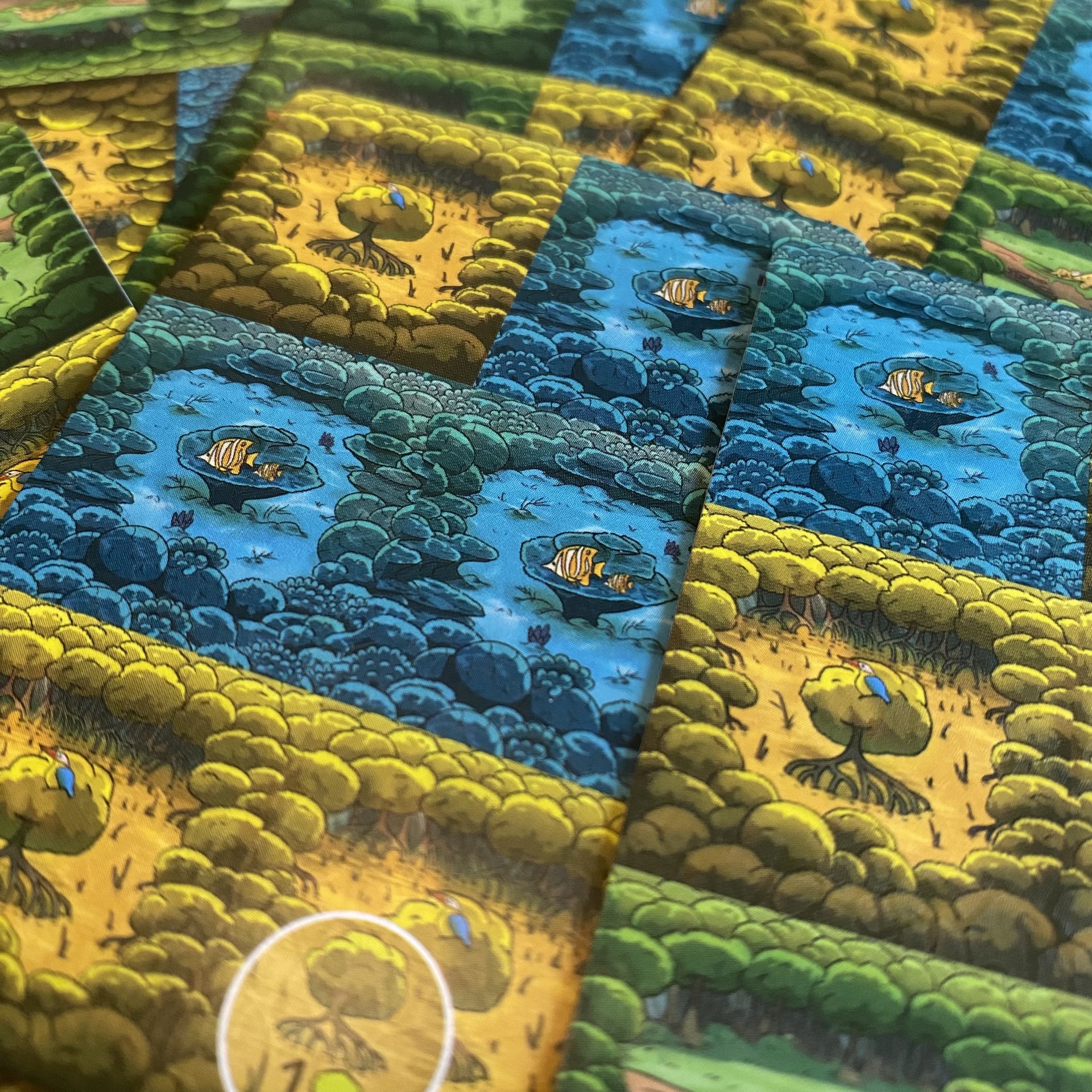
The artwork throughout the game is eye-catchingly colourful. Both the habitat cards and wildlife tokens are beautiful, it’s just a shame that so much of the habitat is covered by the tokens. I feel like the habitat cards should be about twenty-five percent bigger to better accommodate the tokens and make everything feel less fiddly.

But those complaints aside, it’s a fun little filler of a game taking about 20-30 minutes to play through and there’s plenty of scope for expanding the experience with the various different goal cards offering bonus points for the largest area of a certain habitat or for having a collection of certain types of animals.