Tag Archives: Review

The Whatnot Cabinet

Designer: Steve Finn, Beth Sobel, Eduardo Baraf Publisher: Pencil First Games

What is The Whatnot Cabinet?

Well, it’s a game of nick-nacks, doodads and gubbins. In the broadest of strokes, it’s similar to Sagrada, in that you’re drafting items to your board, but rather than making a magnificent window, you’re gathering stuff that’s going to be an absolute nightmare to dust.

You have an empty cabinet with twelve empty spaces just crying out to be filled with interesting little trinkets that you’ve picked up here and there. By arranging these bits-and-bobs in particular ways you can score points – horizontal by type, vertically by colour – as well as picking up further points for fulfilling certain criteria as the game goes along. Maybe a bonus for filling the corners first, or the same items on one row and different items on another – and once that bonus has been scored, it’s off the table for the remaining players, so there are some tactical decisions that need to be made.

Everyone has access to the same moves but each move can only be used once each turn (which then determines the turn order next time) and while each move has the same result – two items for your cabinet – how you get those varies from drawing completely blind to resetting what’s available and various points between.

Visually it’s a gorgeous game – as most of Pencil First’s offerings are. Beth Sobel’s artwork is delightful, the whatnots are beautifully represented and your cabinet will look delightful even if you end the game kicking yourself for choosing a green turtle over a purple shell. The whatnot tiles are nice and sturdy and the player pawns are beautifully turned out, being both different shapes and colours.

It’s a quickie too. Gameplay is around twenty minutes or so, and it’s easy to learn, so it can act as a palette cleanser between a couple of bigger games. A nice light and airy game to whet your gaming whistle, while still having a bit of strategy, forward planning and that mix of luck and outrage over an opponent taking the piece you wanted that everyone craves.

Turing Machine

Designer: Fabien Gridel, Yoann Levet Publisher: Scorpion Masque

This is definitely a game which won’t be for everyone. There’s no pieces to move around, outside of the cleverly designed punch cards, and most of the components will remain firmly in the box while you’re playing, but if you’re a fan of deduction and logic puzzles then this game will definitely scratch that particular itch. And then some.

It’s a code deduction game, in a similar vein to Break The Code except rather than trying to determine what numbers your opponents hold, you’re playing against the machine itself. And for what is, essentially, a few cards and a whole lotta holes – this machine is a crafty beast.

It’s a simple game to set-up – each puzzle, whether it’s one of the twenty in the rulebook or the more than seven million online tells you what cards you need to get out. After that it’s just you, a notesheet, a pencil (or a pen if you’re feeling super confident) and your brain. A dry-wipe pen is included but that’s for marking the verification cards so you know which criteria they correspond to in the heat of the moment, you’ll have to source your own code-cracking scribing tool.

Eaxh criteria is, essentially, a question you can ask of the machine – is a number odd or even, high or low, repeated or a lone wolf etc – and by assembling punchcards corresponding to the numbers you want to try you get your answers from verification cards which are an eye-bending mix of red crosses and green ticks until the punchcards filter it down and provide you with an answer, or maybe more questions.

I threw myself in to one of the online puzzles straight from the get go, and got along just fine – it might take a run or two to fully understand what the answers the machine provides mean but once you get your head around the logic involved you’ll be code-breaking with the best of ‘em. And at only twenty minutes or so for each code, you’re going to have another go. And maybe just one more after that…

Run, Animals, Run

Designer: Chih-Fan Chen Publisher: Mizo Games
Distributed by: Taiwan Boardgame Design

Run, Animals, Run is , at face value, a resource collection game in which you guide a group of endangered animals through lush forests, gathering resources to fulfil their survival goals and be the first to score twenty points. But if you pay a little bit more attention there’s a darker message in there too. I suppose the fact that the box art carries the subtitle “Zoo of depression” is a bit of a giveaway.

This, as with many games from Taiwan and Singapore, is a game with a strong environmental theme. While you’re rushing to collect your resources you’re up against both the humans encroaching on the forest – in this case represented by flippable board tiles showing a lush green landscape on one side, and a grey building site on the other – and the ever-swinging scythe of death.

Run out of action cards (of which there are varying numbers depending on your chosen animal but, on average, five) before you complete your current resource goal and the only way to replenish the actions is to kill off one of your animals. And there’s every chance that you’ll be forced to do this, as the board is constantly changing throughout play, flipping from chlorophyll to concrete jungle with the roll of a dice. When the tiles flip, there are less available resources to be gathered with the possibility of this reducing further thanks to the addition of pesky cement cubes blocking off the resource spots.

You need to be methodical with your moves, and I guess that goes towards the narrative that this game is telling. You can’t hang about if you want to save the natural world. You need to make moves that count for something or you’ll find yourselves scrabbling for scraps in the dust.

And, as previously mentioned, the only way to refresh your available move set is to kill off one of your animals – some only start with two or three creatures so doing that is not something that should be taken lightly. This can lead to the game ending abruptly – whether it’s through the extinction of a species (loss of all your playing pieces) or filling up the animal graveyard on the back page of the rule book it’s an immediate end. Someone certainly can win by reaching the points total, but it’s more likely that your game will end suddenly as the last frog in the wild breathes its last.

There are a few issues with the game – the most notable of these being the fact that the flipped image of the building site has been printed incorrectly on the back of the jungle tiles – at least in the version I have played. As you flip the tiles they’re supposed to form an image of the building site but they will, in fact, form this image backwards and nothing will join together. It’s not a gamebreaker by any means, but it is a shame when it’s a mechanic that is also driving home a strong environmental message.

Durian Dash

Designer: Daryl Chow Publisher: Origame

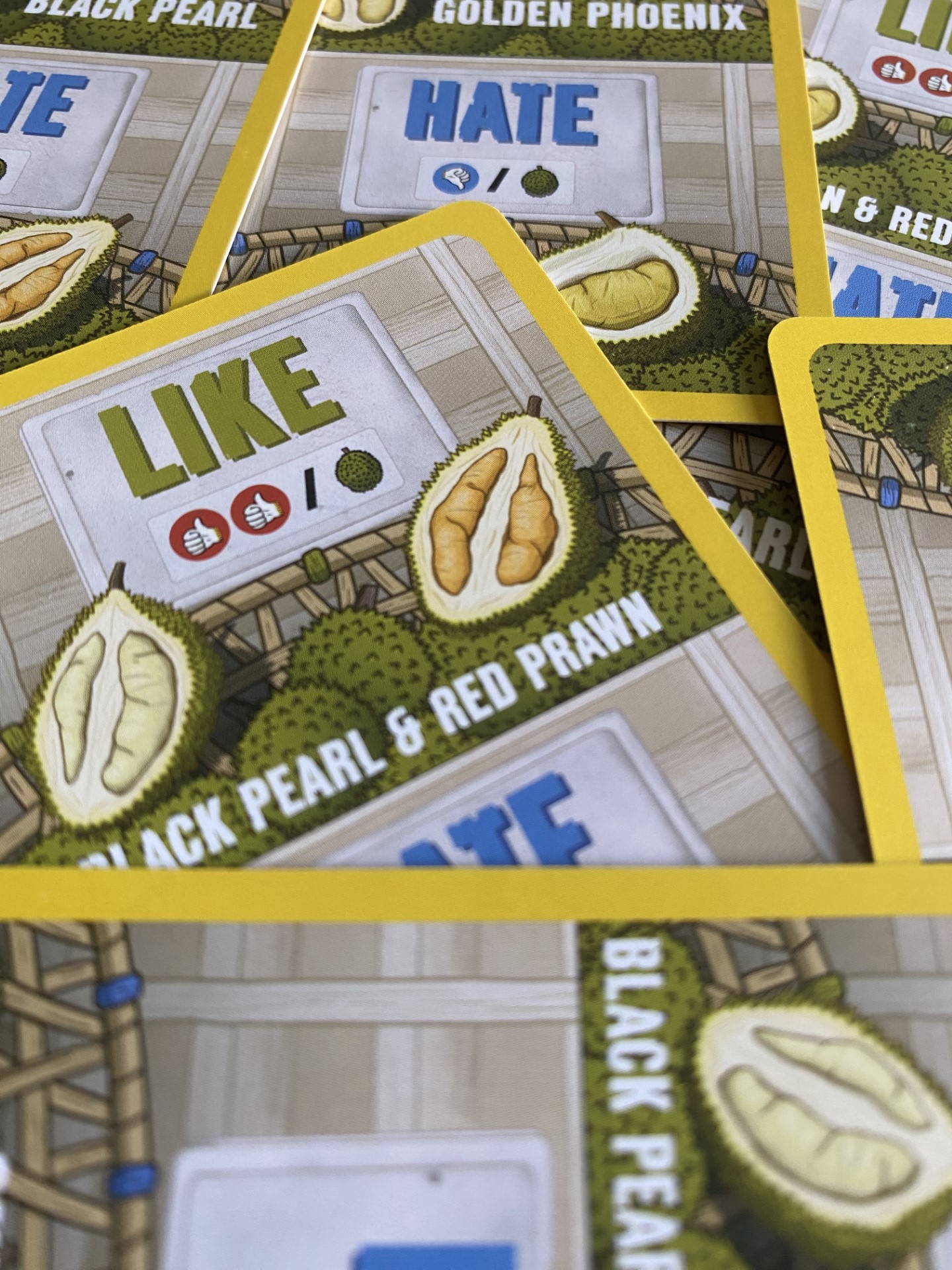
Durian Dash is a game about collecting the “king of fruits”, the incredibly stinky but nutritious and, apparently, delicious durian fruit.

Each player has a secret mission to collect certain types of durian for bonus points and avoid others to dodge penalty points, and gameplay is so simple.

Playing an action card determines what you can do each turn – picking up fruit, placing down fruit or passing fruit to an opponent. The lower your action card number the earlier you take your turn, and as the market isn’t replenished until all players have made their moves it might prove important to get in there first if there’s a durian at the head of the market that takes your fancy – you don’t want to get stuck with the rotten ones! Or maybe you do if you have a handy passing action up your sleeve to give the manky fruits to your opponents. Once each player has taken their actions the market is restocked and play continues until there’s no more cards to replenish the stalls. Tot up your fruits, including any bonuses and negative points and the highest score wins. There’s also a durian hater mode with identical gameplay but you’re aiming for the lowest score.

The art work in this game isn’t particularly eyecatching once you get past the huge abundance of yellow on offer. There’s not a vast array of difference from one durian to the next, aside from the number of stones in each fruit. Each durian type has a different coloured border and identification text but it can get lost in the sea of yellow cards. It wasn’t too much of a problem in a two-player game but with six players there’ll be an awful lot of durians in play and I think it’d be a little bit harder to pick out the ones you want. But then, simplistic artwork for a simple game works brilliantly in things like Point Salad, so it’s not all bad.

One thing that I would mention is that the game box states that the game is for 3-6 players but this is misleading and initially put me off even looking in the box as it’s only about once a week we’ll play as a three(or more)some, but the game is actually for 2-6 players and the the instructions focusing on a two player set-up in many of the examples.

Other than that, it’s another quick, fun and easy to learn game – something which the selection of titles from Origame provides in abundance.

Rainforest City

Designer: Daryl Chow Publisher: Origame

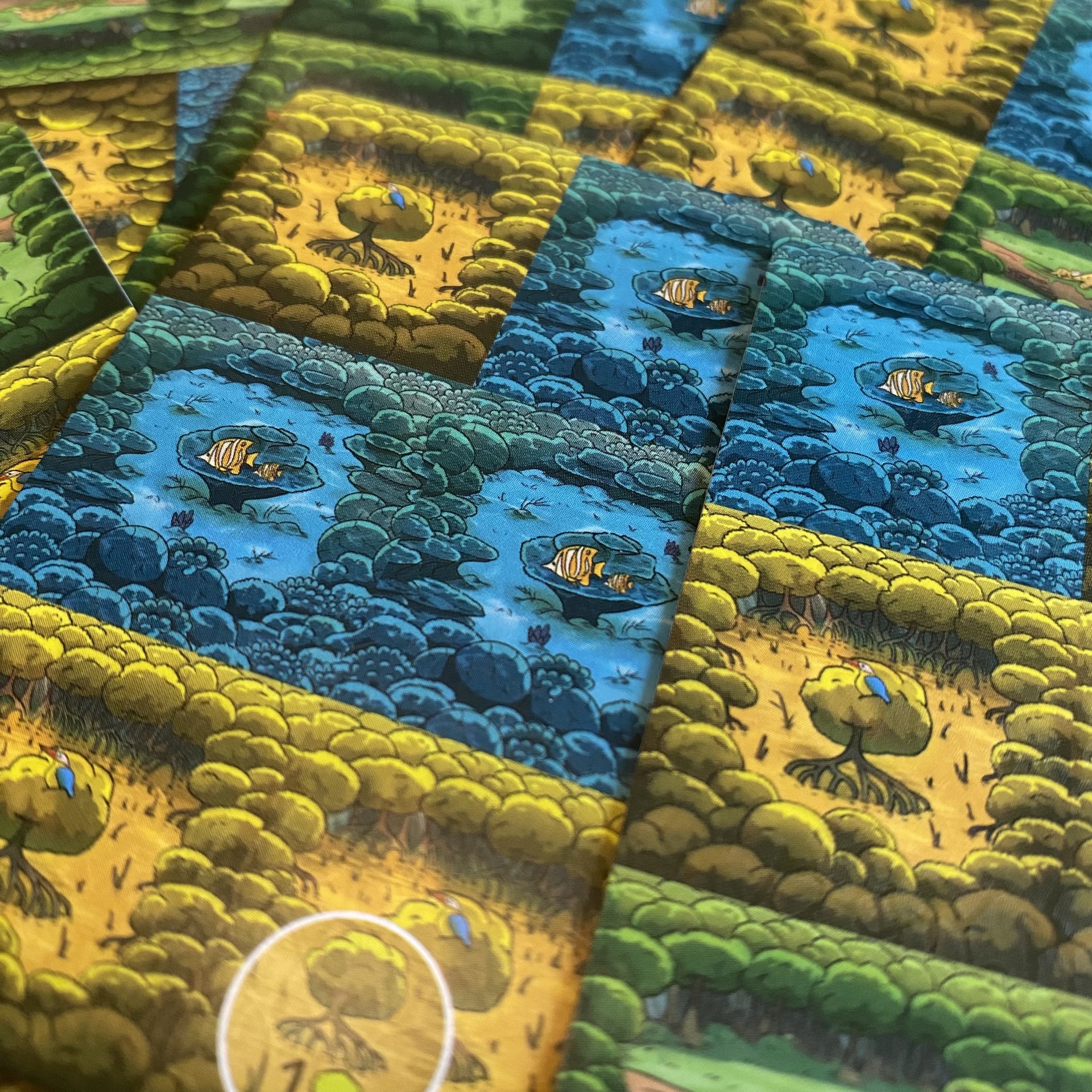
Rainforest City is a nature-themed tile-placement which sees you trying to build the best, most sustainable, habitats for an array of Singapore’s flora and fauna – you’ll be making homes for termites, tree-climbing crabs, and pangolins, amongst others.

Gameplay is simple – each player is assigned a player fruit, and cards are arranged around the central fruit dial offering habitat and wildlife cards in various configurations. On your turn, you turn the fruit dial to the cards you want and take both to place into your landscape, your opponents take one card from the section their fruit is pointing at.

Habitat cards, plus any wildlife on the cards, are played directly into your landscape with the goal of creating large, wildlife-rich areas.

Wildlife cards present a 2×3 grid – you can rotate the card as you wish but the idea is to place the wildlife orientation shown on the card into the correct habitat(s). Anything you’re unable to place goes into the compost bin for negative points.

The game continues, with main player duties rotating, until twelve rounds have been played. And then it’s final scoring time.

Final scoring is both simple and clunky at the same time. You score points for supported fauna, so you need to work out what is, and isn’t, supported in each habitat, which can be a little fiddly when your board is littered with wildlife tokens which cover most of the square they’re on – especially when it comes to the otters, which can be played into any habitat, so you need to pay more attention to where their dinner is coming from. There’s also some scoring which is not adequately explained in the instructions, coming as both a surprise when you get to the end game score section and a bit of a “how do you interpret this?” moment which is not something you want at the end of what is a quick and fun game.

The artwork throughout the game is eye-catchingly colourful. Both the habitat cards and wildlife tokens are beautiful, it’s just a shame that so much of the habitat is covered by the tokens. I feel like the habitat cards should be about twenty-five percent bigger to better accommodate the tokens and make everything feel less fiddly.

But those complaints aside, it’s a fun little filler of a game taking about 20-30 minutes to play through and there’s plenty of scope for expanding the experience with the various different goal cards offering bonus points for the largest area of a certain habitat or for having a collection of certain types of animals.